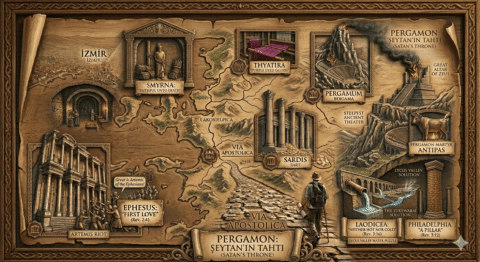
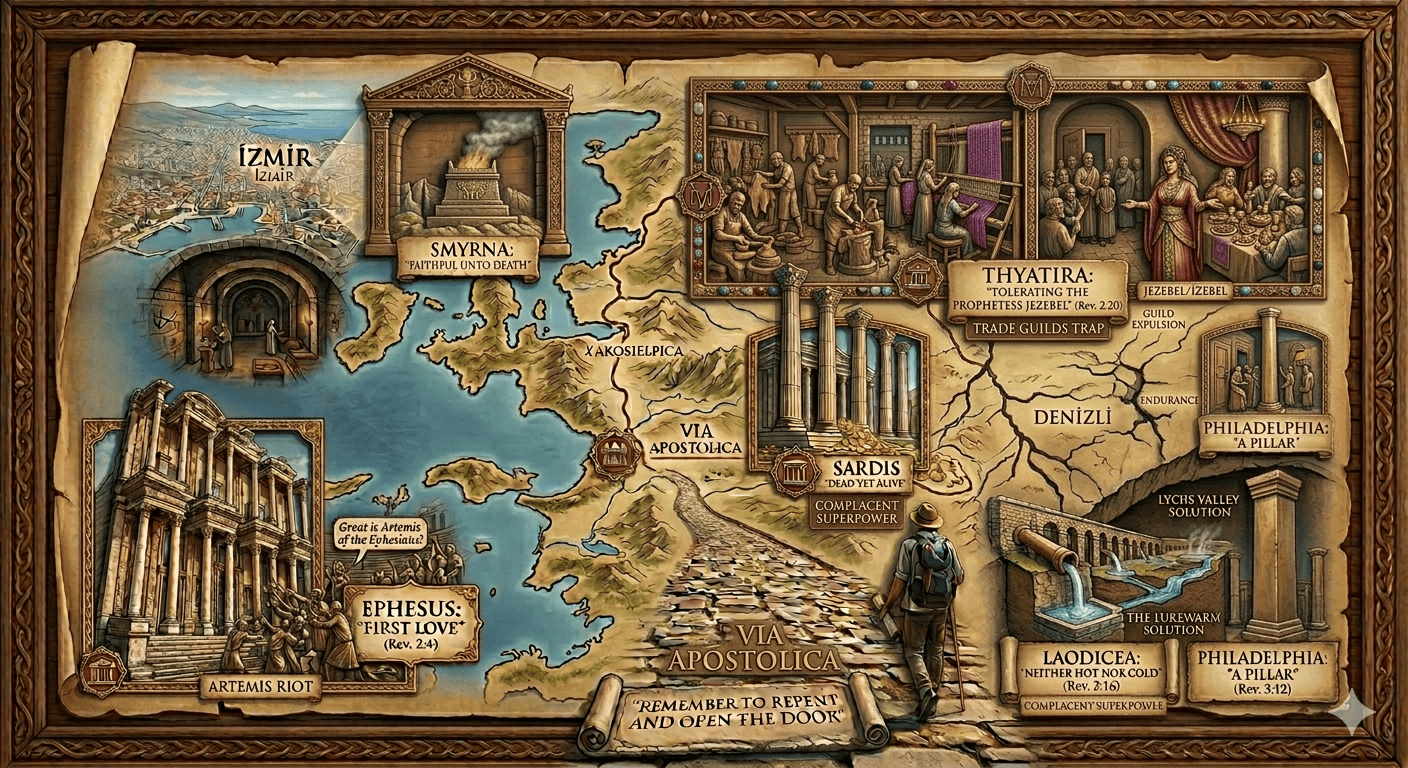
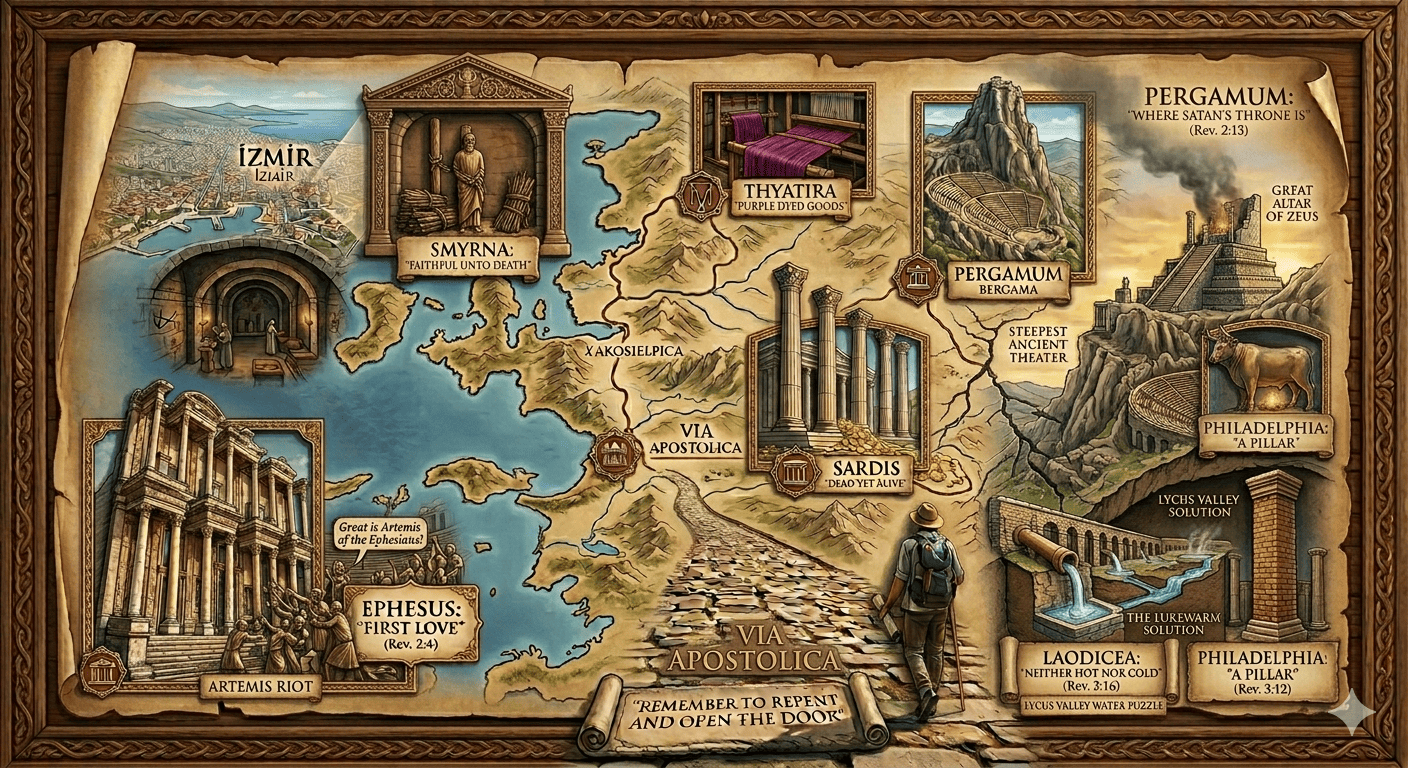
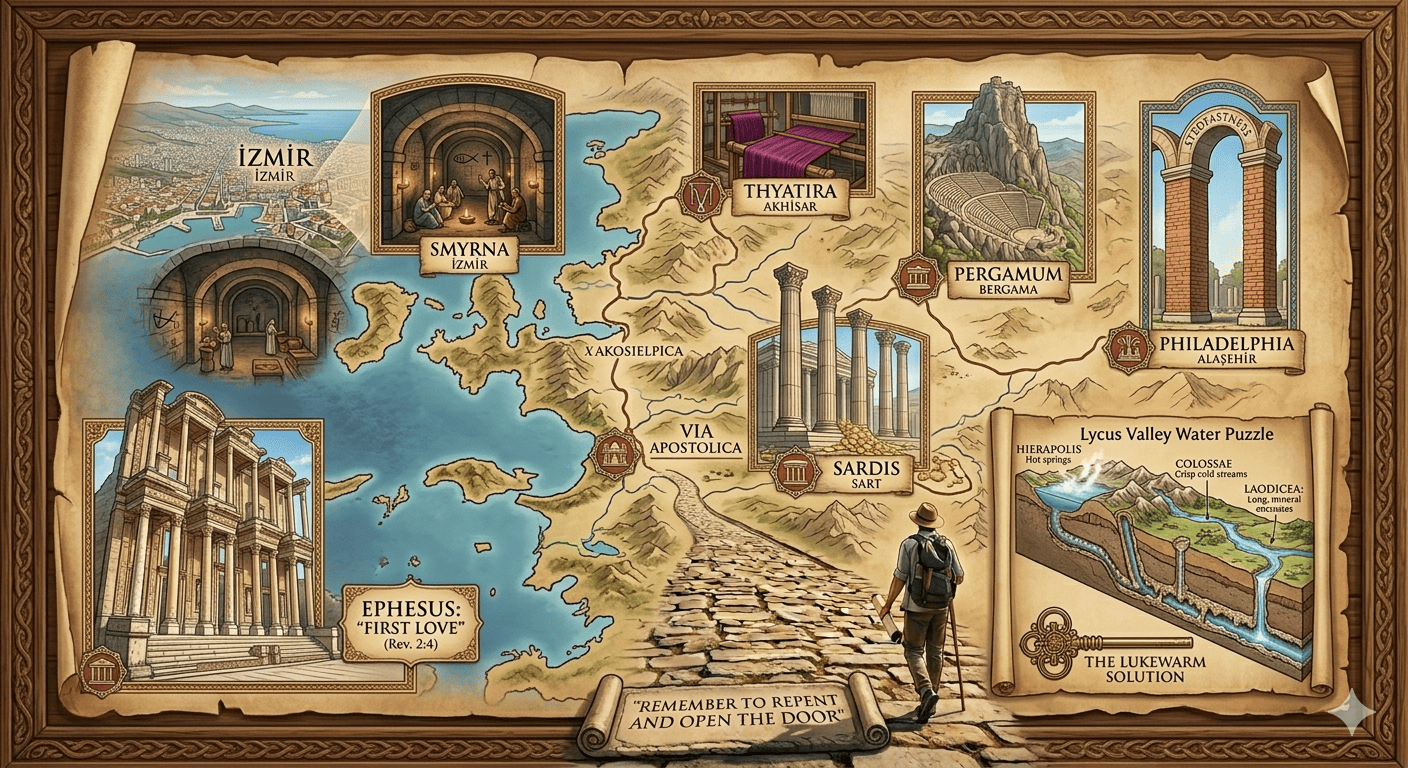
If you were to approach the ancient city of Pergamum in the first century, you would see it long before you arrived. Rising nearly a thousand feet above the surrounding valley, a sheer, precipitous hill held a city of breathtaking architectural audacity. Pergamum was not just a city; it was an imposing mountain fortress turned into a glittering, elite capital of culture, pagan religion, and Roman power.
Pergamum boasted the steepest theater in the ancient world, clinging dramatically to the hillside, and a legendary library holding over 200,000 parchment scrolls—rivaling even the Great Library of Alexandria.
Yet, when the risen Christ dictated His letter to this magnificent city in the Book of Revelation, He bypassed its cultural achievements and addressed a dark, imposing spiritual reality. He referred to Pergamum as the place “where Satan has his throne.”
Why did this center of classical beauty receive such a chilling title? What secrets were carved into the stones of this towering acropolis that triggered such a fierce biblical warning?
Unmasking "Satan’s Throne"
The phrase “where Satan has his throne” (Revelation 2:13) is not just a poetic metaphor; it was a highly specific reference to the literal landscape and political climate of first-century Pergamum. Historians and biblical scholars point to three massive monuments that defined the city’s spiritual shadow:
1. The Great Altar of Zeus
Dominating the terrace just below the summit of the acropolis was the colossal Altar of Zeus. Looking out over the valley, smoke continuously rose from this massive structure as sacrifices were burned day and night. From a distance, the architectural layout of the altar resembled a giant, stone throne cut directly into the mountainside. To the early Christians looking up from the valley, this continuous pagan smoke and giant structure felt like the literal seat of spiritual adversary.
2. The Asklepion: The Center of Healing and Serpents
At the base of the mountain lay the Asklepion, one of the most famous medical and psychiatric centers of the ancient world. Dedicated to Asklepios, the god of healing, its prominent symbol was a snake wrapped around a staff (a symbol still used in medicine today). Patients from across the empire traveled here, sleeping in dark rooms where harmless snakes crawled across the floors, believing the god would heal them in their dreams. To the early believers, who recognized the serpent as the biblical symbol of deception, a city dedicated to the worship of a snake-god was deeply troubling.
3. The Cult of Imperial Rome
Above all, Pergamum was the official administrative capital of the Roman province of Asia. It was the very first city to build a temple to a living emperor (Augustus Caesar) in 29 BC. In Pergamum, politics and religion were entirely fused. Refusing to worship the emperor was viewed not just as a religious choice, but as political treason against the state.
The Commendation and the Compromise
Living under the literal shadow of Roman execution and pagan supremacy, the Christians of Pergamum displayed incredible bravery. Christ praised them for remaining true to His name, specifically remembering Antipas, who was martyred in the city. According to early church tradition, Antipas was placed inside a hollow bronze bull, which was then heated with fire until he roasted to death—yet he refused to deny his faith.
However, the letter also carries a sharp rebuke. While they withstood violent persecution from the outside, they were slowly being compromised from the inside.
A group within the church, referred to as the followers of Balaam and the Nicolaitans, was advocating for a quiet compromise. They argued that a little blending with pagan culture—eating meat sacrificed to idols and participating in loose civic feasts—was necessary to survive economically in Pergamum.
Christ’s warning to them was absolute: Repent, or He would come quickly and fight against them with the sword of His mouth. True faith could not coexist with calculated compromise.
Walking Through Pergamum Today: The Dramatic Heights of Bergama
Today, the majestic acropolis of Pergamum looms over the modern Turkish town of Bergama. To visit this site is an unforgettable journey into ancient engineering and spiritual gravity:
The Steeps of the Acropolis: A modern cable car whisks visitors up the steep hillside to the ruins. Walking through the foundations of the royal palaces, the Temple of Trajan with its gleaming white marble pillars, and the vast library courtyard, you instantly feel the sheer elitism of the city.
The Vertical Theater: To sit on the stone rows of the Pergamum theater—which drops at an astonishing 70-degree angle into the hillside—is a spine-chilling experience. Looking out across the vast valley from this vantage point, you realize exactly how visible and exposed the early Christian community was.
The Void of the Altar: While the original, intricate friezes of the Great Altar of Zeus were excavated in the 19th century and taken to the Pergamon Museum in Berlin, the original stone foundation still stands on the hillside, shaded by ancient trees. Standing on that empty stone platform, you can still feel the weight of the words written to the early saints who looked up at this exact spot.
The Hidden Manna and the White Stone
To the believers who refused to compromise with Pergamum’s lavish pagan banquets, Christ made a brilliant, contrasting promise: “I will give some of the hidden manna. I will also give that person a white stone with a new name written on it…” (Revelation 2:17).
In the ancient world, a white stone was used in courts of law to signify acquittal (innocence), and it was also used as an exclusive admission ticket to royal banquets. Christ was telling the marginalized believers of Pergamum: Rome may condemn you, and pagan society may lock you out of their feasts, but I have acquitted you, and your ticket to the eternal banquet is entirely secure.
The grandeur of Roman Pergamum has long since turned to dust, but its stones still whisper a timeless lesson to every modern pilgrim: the higher the stakes and the greater the pressure to compromise, the more brilliant the eternal reward becomes.
Are you ready to stand on the breathtaking heights of the Pergamum Acropolis and uncover its biblical secrets? Explore our exclusive [Seven Churches of Revelation Itineraries] or connect with us to craft a custom spiritual pilgrimage through Turkey today.