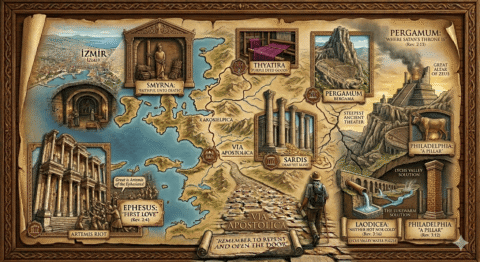
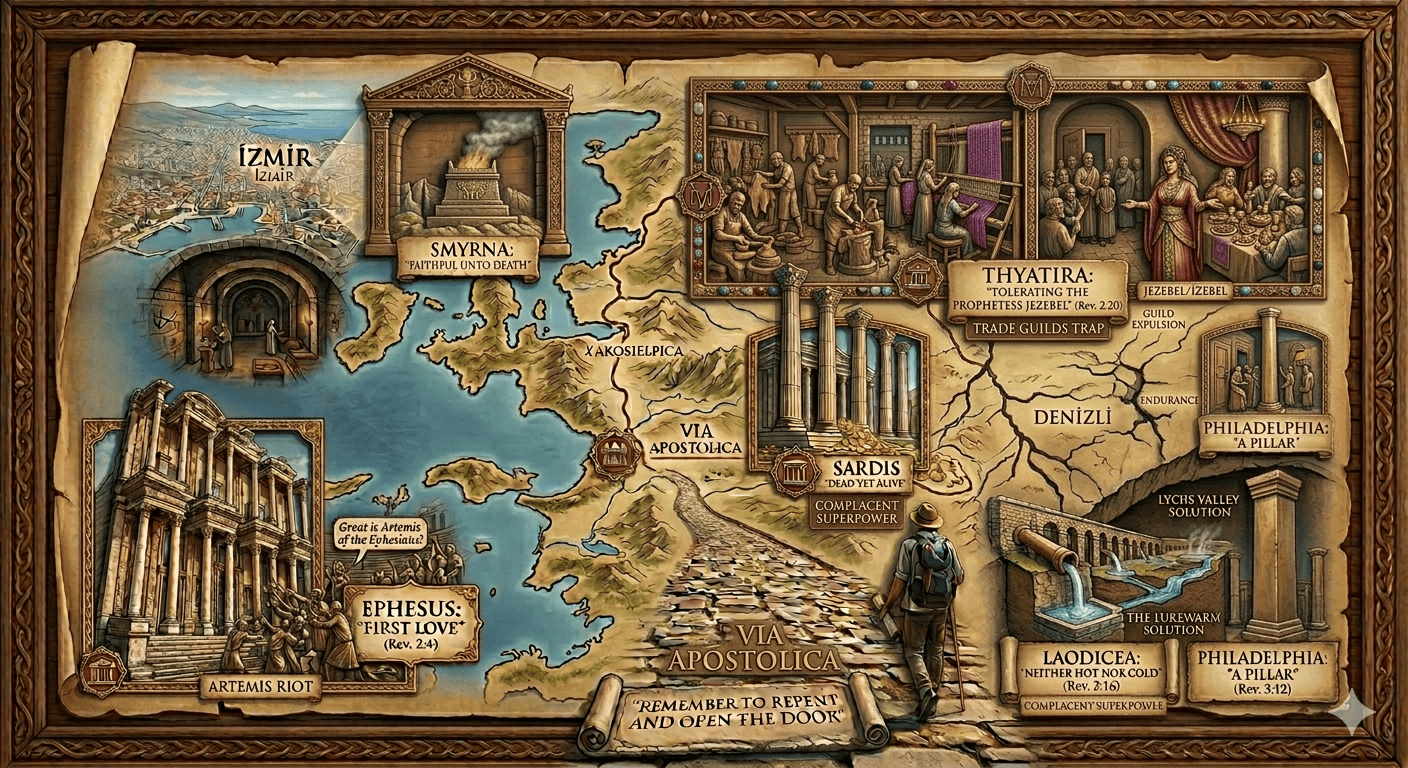
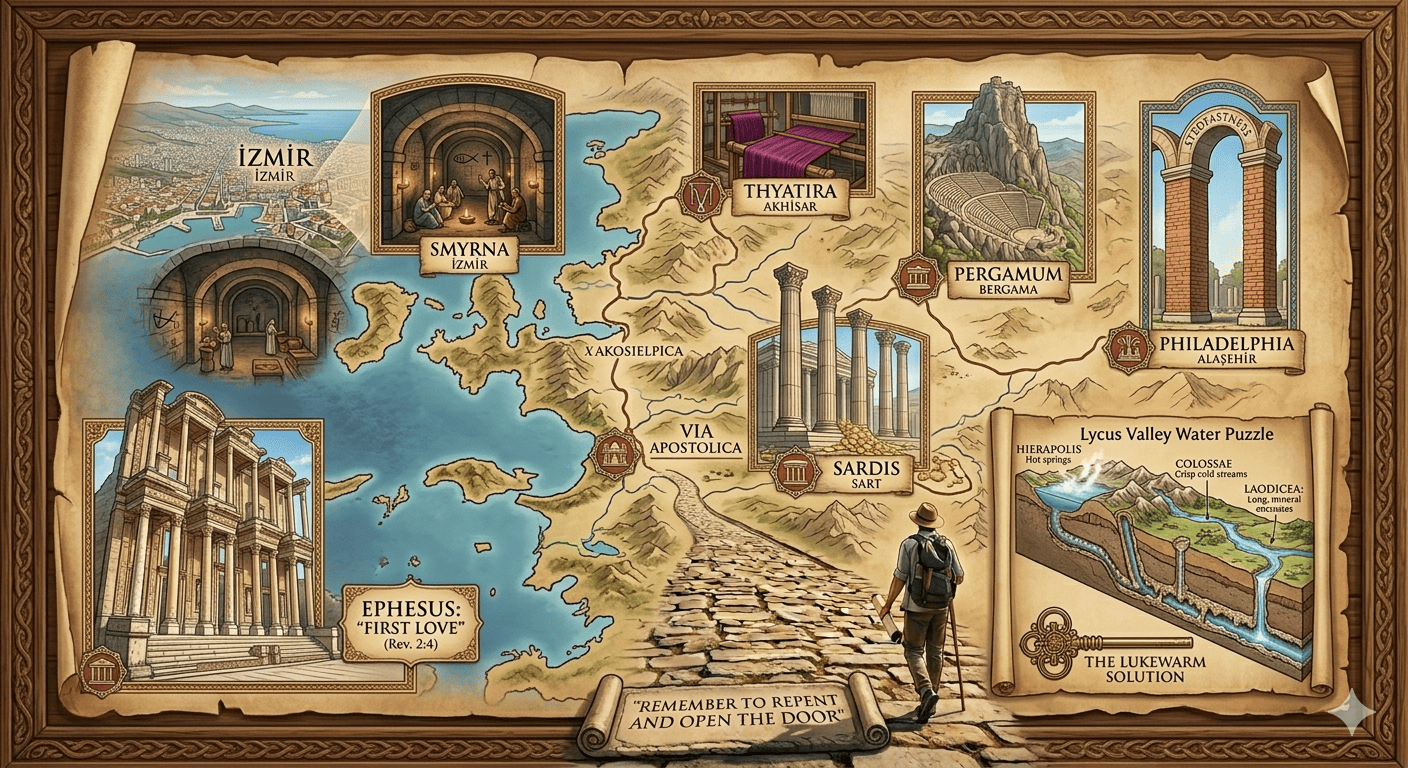
As you travel inland from the Aegean coast, leaving the bustling ports of Ephesus and Smyrna behind, the ancient Roman road cuts through the dramatic, fertile valleys of modern-day Manisa. Here, separated by just an afternoon’s journey, stood two prominent cities of Asia Minor that received two of the most contrasting letters in the Book of Revelation: Sardis and Philadelphia.
Their proximity makes their spiritual diagnoses all the more striking. One city was legendary for its past imperial glory and massive wealth, yet it received a chilling death certificate. The other was a modest, earthquake-shaken border town with little worldly power, yet it received an unblemished certificate of honor.
Together, Sardis and his neighbor Philadelphia present a timeless study in contrasts: the church that was dead despite looking alive, and the church that was vibrantly alive despite looking weak.
Sardis: The Church with a Reputation (Modern-Day: Sart)
Centuries before the Apostle John picked up his pen, Sardis was one of the most legendary superpowers of the ancient world. It was the ultra-wealthy capital of the Lydian Empire, ruled by King Croesus, who famously minted the world’s first gold coins. The city was built upon a soaring, sheer cliffside that made it an impregnable mountain fortress.
Because of this natural advantage, the citizens of Sardis grew notoriously arrogant and complacent. They believed no enemy could ever scale their cliffs. Yet, twice in its history—once by Cyrus the Great of Persia and later by Antiochus the Great—the city was conquered. In both instances, the enemy did not breach the gates; they simply sent a few soldiers to climb up the unguarded, silent cliffs at night while the Sardian sentries slept, entirely unaware.
By the first century, Sardis had lost its political sovereignty but retained its massive wealth and vanity. To this seemingly prosperous community, Christ delivered a devastating blow in Revelation 3:1:
“I know your deeds; you have a reputation of being alive, but you are dead. Wake up! Strengthen what remains and is about to die…”
The spiritual reality of Sardis perfectly mirrored its military history. The church was busy, respectable, and carried a great reputation in society. It faced no violent persecution and no internal heresies—largely because it wasn’t doing anything spiritually significant enough to threaten pagan culture. They had fallen into a deep, complacent sleep. Just like their ancient sentries, their lack of spiritual watchfulness was leading them to a quiet, catastrophic collapse.
Philadelphia: The Church of the Open Door (Modern-Day: Alaşehir)
In stark contrast to the ancient prestige of Sardis stood Philadelphia. Founded much later by the Pergamene kings, the city was built as a cultural and linguistic gateway to spread Greek culture into the rugged interior of Phrygia.
However, Philadelphia had a terrifying geographical flaw: it sat directly on a major geological fault line. In 17 AD, a monumental earthquake devastated the region. While Sardis rebuilt quickly, Philadelphia suffered aftershocks for years. The citizens lived in a state of perpetual anxiety; many abandoned the city entirely to live in tents in the open countryside, terrified that the stone roofs of their magnificent public buildings would collapse on them at any moment.
The Christian community here was physically small, financially poor, and carried “little strength.” Yet, Christ’s letter to Philadelphia contains not a single word of rebuke. Instead, He honors their endurance and presents them with a magnificent promise in Revelation 3:8:
“I know that you have little strength, yet you have kept my word and have not denied my name. See, I have placed before you an open door that no one can shut.”
While Sardis was a fortress that fell due to complacency, Philadelphia was an open door that stayed secure due to dependency. Because they knew their own weakness, the Philadelphia believers relied entirely on the strength of God.
Walking Through the Ruins Today: The Pillars of Faith
To explore the archaeological remnants of these two sister cities in modern Turkey is to see the physical manifestations of their biblical letters:
The Colossal Ruins of Sardis: Located near the village of Sart, the archaeological site is awe-inspiring. Visitors can walk through a massive, beautifully restored Roman Gymnasium complex and explore one of the largest ancient Jewish Synagogues ever uncovered. Nearby stand the colossal columns of the Temple of Artemis, towering over the landscape. Looking at the sheer scale of these monuments, you understand the “reputation of being alive.” Yet, the silence of these ruins underscores the sobering reality of spiritual death.
The Monolithic Pillars of Philadelphia: Located within the modern city of Alaşehir, most of the ancient city remains buried beneath modern urban life. However, standing proudly in an open archaeological park are the jaw-dropping, towering brick pillars of the 6th-century Church of St. John. These massive, unshakeable pillars serve as a stunning physical echo of the promise Christ made to the faithful Philadelphia believers in Revelation 3:12: “The one who is victorious I will make a pillar in the temple of my God, and never again will they leave it.”
The Permanent Inscription
To the sleeping church of Sardis, Christ promised that the few who remained faithful would walk with Him in white garments, their names securely held in the Book of Life. To the trembling but steadfast church of Philadelphia, He promised to write upon them the name of God and the name of the New Jerusalem.
Sardis teaches us that external success, grand architecture, and a glittering reputation mean nothing if the heart has grown cold and asleep. Philadelphia teaches us that when we feel our weakest, shaking under the earthquakes of life, our dependency on God turns us into permanent pillars that can never be shaken down.
Are you ready to witness the staggering contrasts between Sardis and Philadelphia with your own eyes? Explore our thoughtfully curated [Seven Churches of Revelation Itineraries] or let us craft a custom spiritual pilgrimage through the ancient valleys of Turkey for your group.