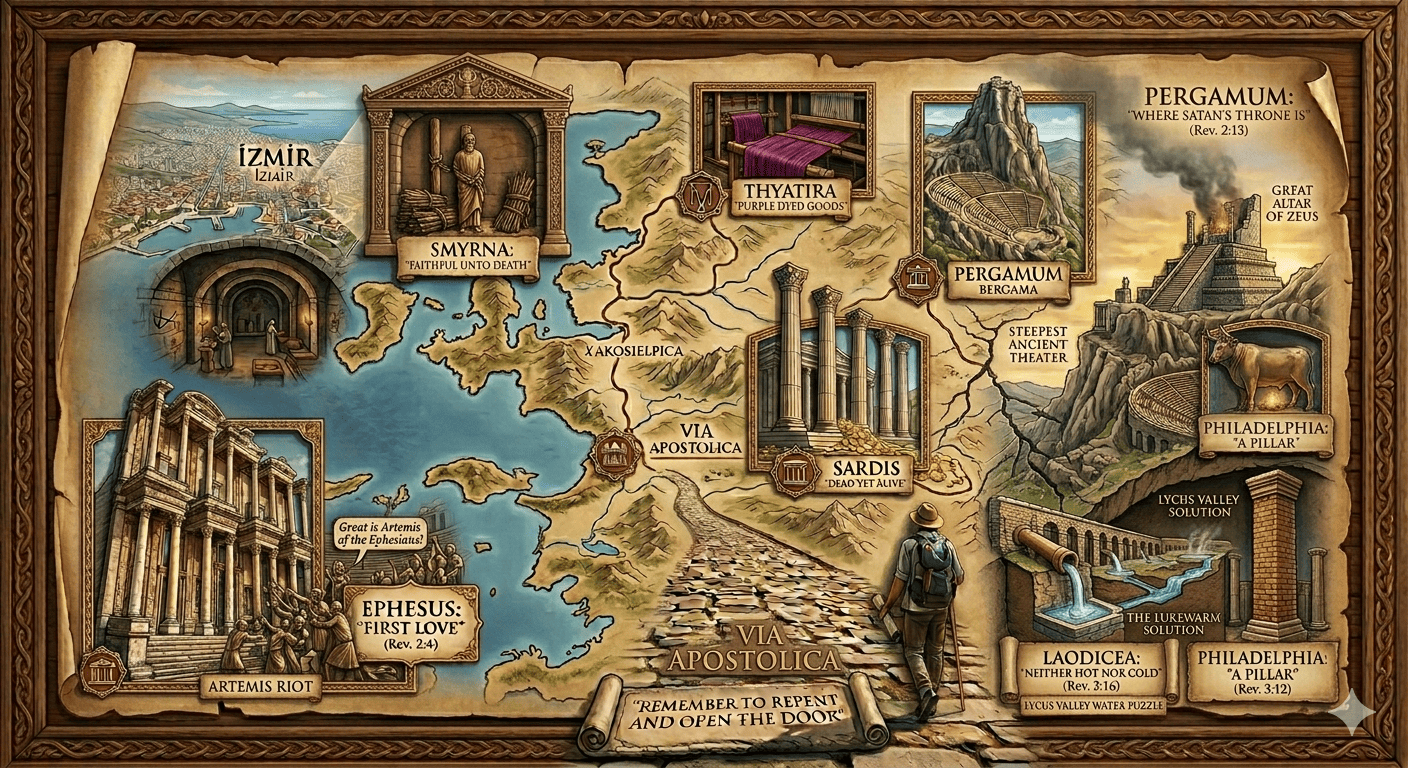
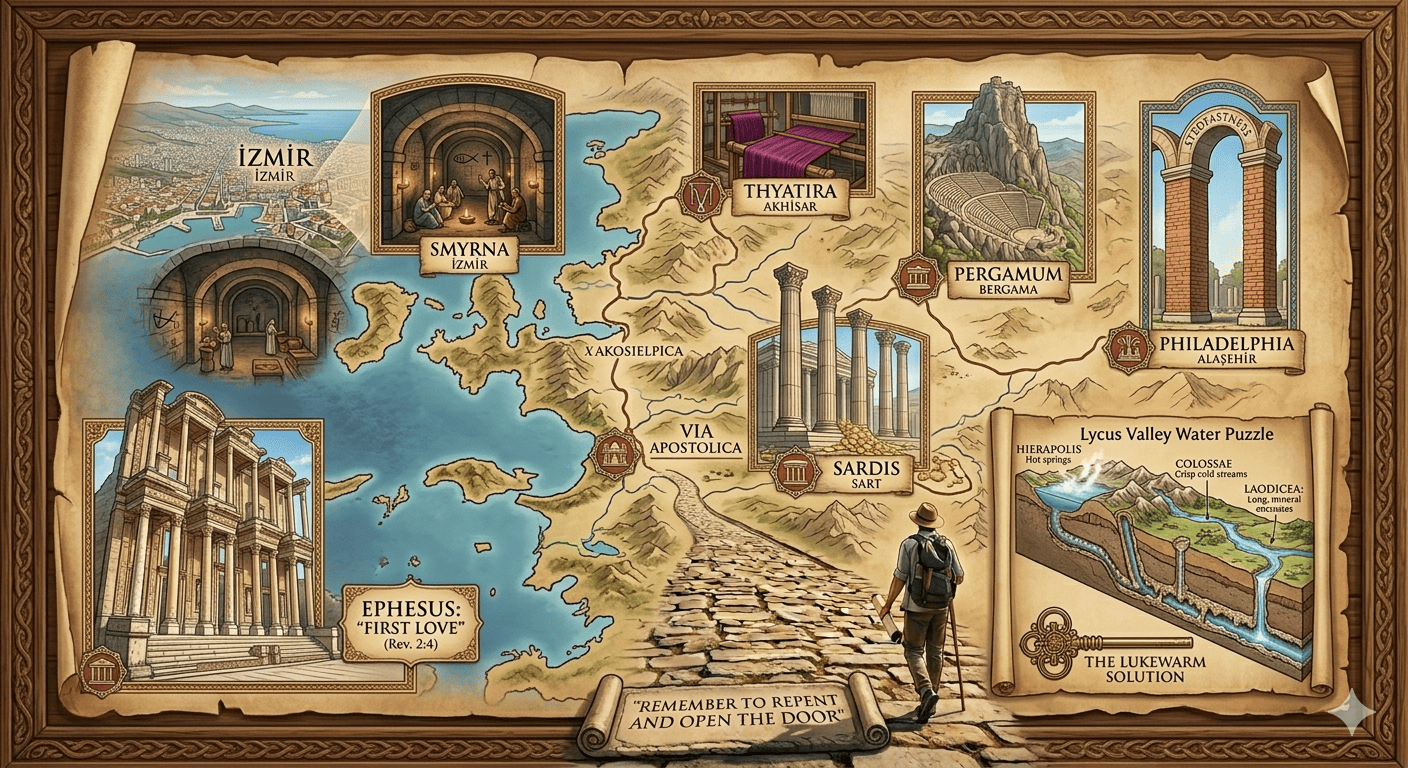
Of all the locations addressed in the apocalyptic letters of Revelation, Thyatira is undoubtedly the least known and most frequently overlooked by modern travelers. Unlike towering Pergamum or wealthy Laodicea, Thyatira was not built upon an impregnable mountain crag, nor was it a glittering regional capital. It sat in a low, wide valley—near modern-day Akhisar—making it militarily vulnerable and structurally modest.
Yet, to this small, unremarkable garrison town, Jesus Christ sent the longest and structurally most complex letter of the Seven Churches.
While Thyatira lacked political prestige, it possessed an economic engine that created a unique and suffocating trap for the early Christians. To survive in Thyatira, believers had to navigate a daily minefield of corporate compromise, pagan rituals, and a dangerous internal heresy led by a prophetic figure nicknamed “Jezebel.”
The Power of the Guilds: The Economic Trap
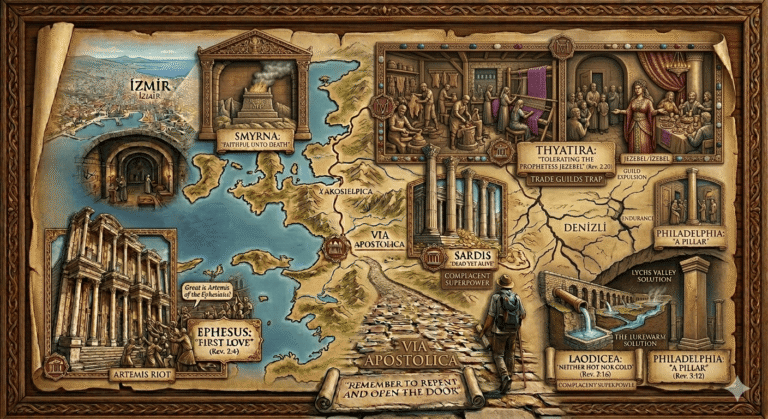
Thyatira was a bustling blue-collar manufacturing hub. It was famous across the Roman Empire for its specialized trade guilds: potters, tanners, bakers, bronze-smiths, and wool-weavers. It was also the premier center for the lucrative purple-dye industry—a detail confirmed by the Book of Acts, which notes that Lydia, a wealthy seller of purple goods in Philippi, was originally from Thyatira.
However, these trade guilds operated like ancient unions with a pagan twist. To hold a job, run a shop, or buy raw materials, you had to belong to a guild.
The crisis for early Christians arose because every guild meeting was held in honor of a pagan deity (often Apollo Tyrimnos). These mandatory corporate gatherings involved pouring out libations to idols, eating meat sacrificed to pagan gods, and frequently degenerating into wild, immoral after-parties.
If a Christian refused to attend, they were expelled from the guild. Expulsion meant immediate financial ruin, bankruptcy, and social ostracization.
The Heresy of "Jezebel"
Unlike the church in Smyrna, which faced intense persecution from the outside, the church in Thyatira was thriving internally in love, faith, and service. Christ praised them, noting that their latter deeds were greater than at first (Revelation 2:19).
But a cancer was growing from within. Christ brings a heavy charge against them:
“Nevertheless, I have this against you: You tolerate that woman Jezebel, who calls herself a prophet. By her teaching she misleads my servants into sexual immorality and the eating of food sacrificed to idols.” (Revelation 2:20)
“Jezebel” was likely a prominent, influential woman within the Thyatiran church who advocated for cultural compromise. She was the first-century advocate of “business pragmatism.” Her message to the working-class believers was highly tempting: God understands your heart. Go to the guild feasts, bow your head to the idol just to keep your business open, and protect your family from poverty. It’s just a formality.
Christ exposes this teaching not as harmless economic survival, but as spiritual adultery. He warned that those who chose comfort over cross-bearing would face severe divine judgment.
Walking Through Thyatira Today: The Heart of Akhisar
Because Thyatira was built on a flat valley, the ancient ruins were entirely swallowed up by the growth of the modern Turkish city of Akhisar. For centuries, the biblical city lay completely hidden beneath bustling residential streets and modern marketplaces.
However, right in the absolute center of modern Akhisar, a single city block has been preserved as an open-air archaeological park known as the Tepe Mezarlığı (Hill Cemetery) ruins:
The Columns in the Downtown: Standing in this intimate excavation site, surrounded by modern apartment buildings with balconies looking down at you, you can walk among a beautiful 4th-century Byzantine basilica complex, a grand Roman colonnaded street, and ancient stone sarcophagi.
The Textile and Bronze Echoes: As you explore the site, you can look closely at the ancient stone foundations that once housed the busy workshops of the tanners and weavers. The contrast between the ancient ruins and the vibrant modern commerce surrounding the fences brings the corporate struggles of the early Thyatiran saints into sharp, tangible focus.
The Morning Star and the Iron Scepter
To the working-class believers of Thyatira who refused to bow to the corporate gods of Rome, Christ made an astonishingly grand promise. He promised them authority over nations, the ability to rule with an iron scepter, and the ultimate prize: “I will also give them the morning star.” (Revelation 2:28).
To a church that felt small, vulnerable, and economically crushed by the powerful local guilds, Christ reminded them that they were destined for cosmic authority. The powerful trade guilds of Thyatira have completely vanished into history, but the legacy of the saints who refused to compromise their purity for a paycheck remains eternal.
This concludes our journey through the Seven Churches of Revelation. From the lost love of Ephesus to the purple-dyed struggles of Thyatira, the stones of Turkey continue to speak to the modern world. Explore our full [Seven Churches of Revelation Master Itineraries] or connect with us to book your definitive spiritual pilgrimage today.