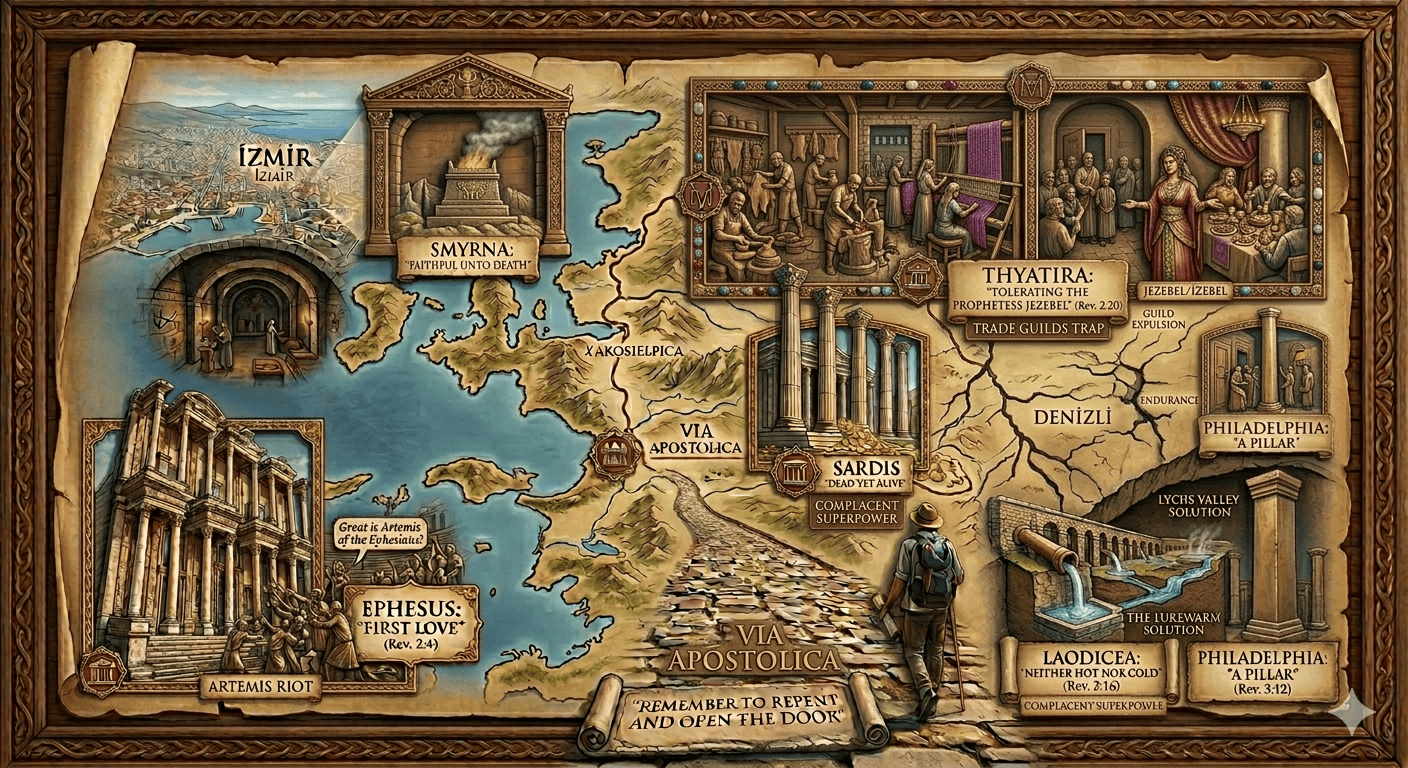
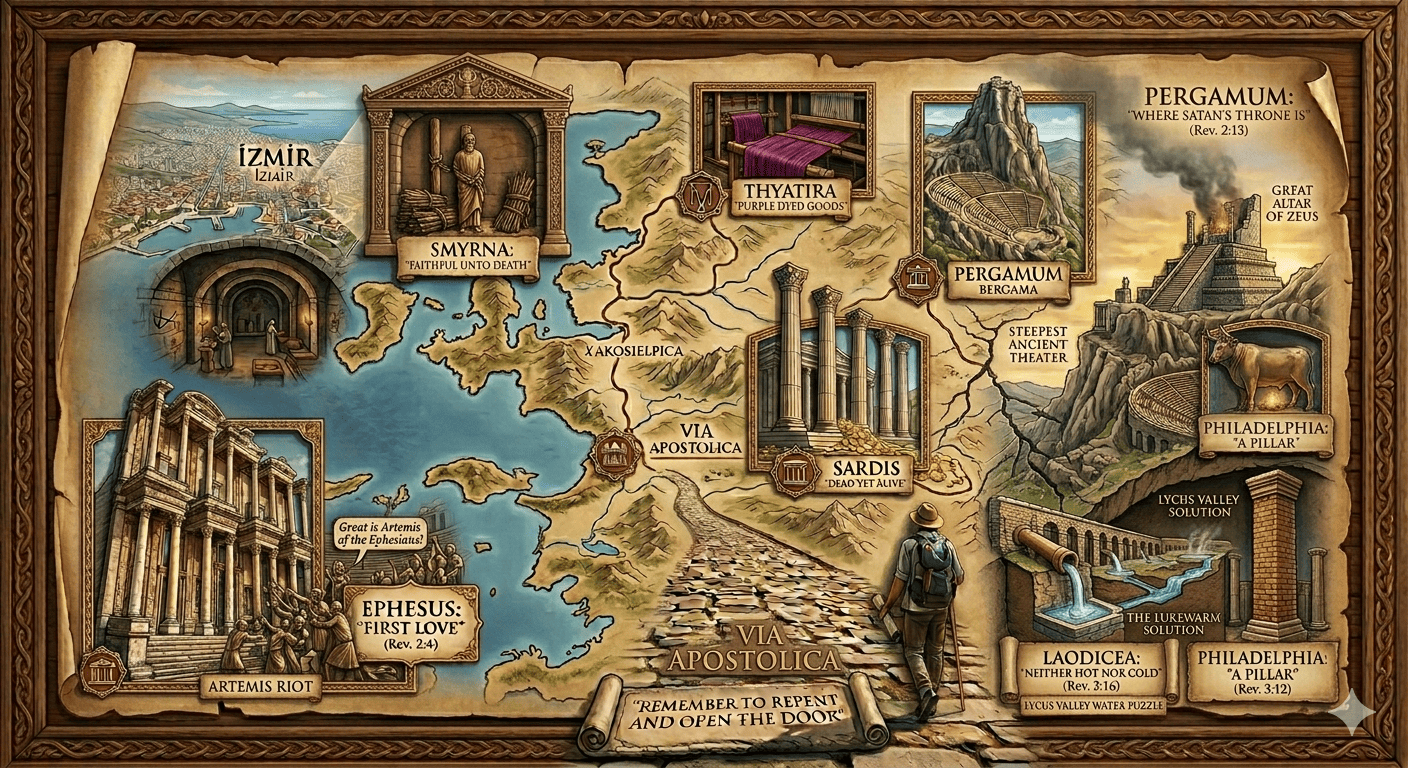
If you were to travel back to the first century and step off a ship into the harbor of Ephesus, your senses would be instantly overwhelmed. You would find yourself in the undisputed crown jewel of Roman Asia—a bustling, wealthy metropolis of over 250,000 people, where grand marble avenues stretched toward a harbor filled with ships from across the Mediterranean.
Ephesus was a city of monumental prestige. It was home to the towering Temple of Artemis, one of the Seven Wonders of the Ancient World, and boasted a massive 25,000-seat theater that echoed with the roar of civic pride and pagan devotion.
Yet, beneath this dazzling display of Roman and Greek grandeur, a quiet spiritual revolution was taking place. Ephesus became the beating heart of the early Christian movement. It was a church with an unmatched spiritual pedigree—planted by Paul, nurtured by Timothy, and served by the Apostle John himself.
But in the twilight of the first century, the risen Christ sent a profound and piercing letter to this highly successful community in the Book of Revelation. His words praised their fierce devotion but delivered a sobering diagnosis: “You have left your first love.”
The Pedigree of Excellence: What Ephesus Did Right
In Revelation 2:2-3, the letter opens with high praise. Christ acknowledges the Ephesian believers for their hard work, their patient endurance, and their absolute refusal to tolerate wickedness.
Living in a city dominated by the occult, emperor worship, and moral decadence, the Christians of Ephesus did not compromise. They were spiritually vigilant. When false apostles traveled through Asia Minor spreading distorted doctrines, the Ephesian church tested them, exposed their falsehoods, and guarded the truth with intellectual and theological fierceness.
They were untiring, orthodox, and fiercely committed to holding the line of faith. By all outward metrics, the Church of Ephesus was a model mega-church of the ancient world.
The Piercing Diagnosis: The Missing Fire
Then come the heavy words of verse 4: “Nevertheless, I have this against you, that you have left your first love.”
How could a church that worked so hard, endured so much, and possessed such flawless theology be rebuked so sharply?
The diagnosis was a matter of the heart. In their relentless battle to defend the truth and maintain organizational excellence, the Ephesians had let their vibrant, passionate devotion grow cold. The fierce, burning love they initially had for Christ—and subsequently for one another—had hardened into mechanical duty. They were doing all the right things, but they were doing them without the heartbeat of love. Their orthodoxy had survived, but their intimacy had withered.
Christ gave them a simple three-step remedy to recover their soul:
Remember the heights from which they had fallen.
Repent of their coldness.
Do the things they did at first.
If they refused, He warned that He would remove their lampstand from its place.
Walking Through Ephesus Today: The Silent Stones
Today, the ancient harbor of Ephesus has completely silted up, leaving the ruins miles inland near the modern Turkish town of Selçuk. Yet, walking through this archaeological wonder, the biblical narrative ceases to be text on a page—it becomes solid stone under your feet.
As you walk down the magnificent, marble-paved Curetes Street, passing the towering facade of the Celsus Library, you can easily picture the couriers weaving through the crowds, holding the very scroll of Revelation that contained this warning.
Sitting in the rows of the Great Theater, you can still feel the echoes of the historic riot recorded in Acts 19, where the silversmiths shouted, “Great is Artemis of the Ephesians!” for two hours, terrified that Paul’s gospel would ruin their lucrative trade in idols. The Ephesians fought hard against that pagan pressure, just as the letter praised.
Yet, perhaps the most poignant reminder of the Ephesian legacy lies just a short distance from the main ruins: the Basilica of St. John. Built over what historical tradition holds to be the burial site of the Beloved Apostle, these majestic, towering ruins stand under the Aegean sky. John, who wrote so extensively about the supreme importance of love in his gospel and epistles, spent his final days overlooking a city that had once been warned about losing exactly that.
The Timeless Echo of the Lampstand
The physical lampstand of the ancient Ephesian church is gone, buried beneath centuries of history. But the lesson carved into the stones of Ephesus remains starkly alive for modern travelers.
It reminds us that it is entirely possible to be busy, morally upright, and doctrinally flawless—yet completely miss the heart of the journey. Ephesus challenges every pilgrim who walks its ancient streets to ask the same question the early believers had to face: Is the fire of my first love still burning?
Are you ready to walk the marble streets where Paul preached and John wrote? Explore our exclusive [Seven Churches of Revelation Itineraries] or let us craft a deeply personal, custom journey to Ephesus for your group