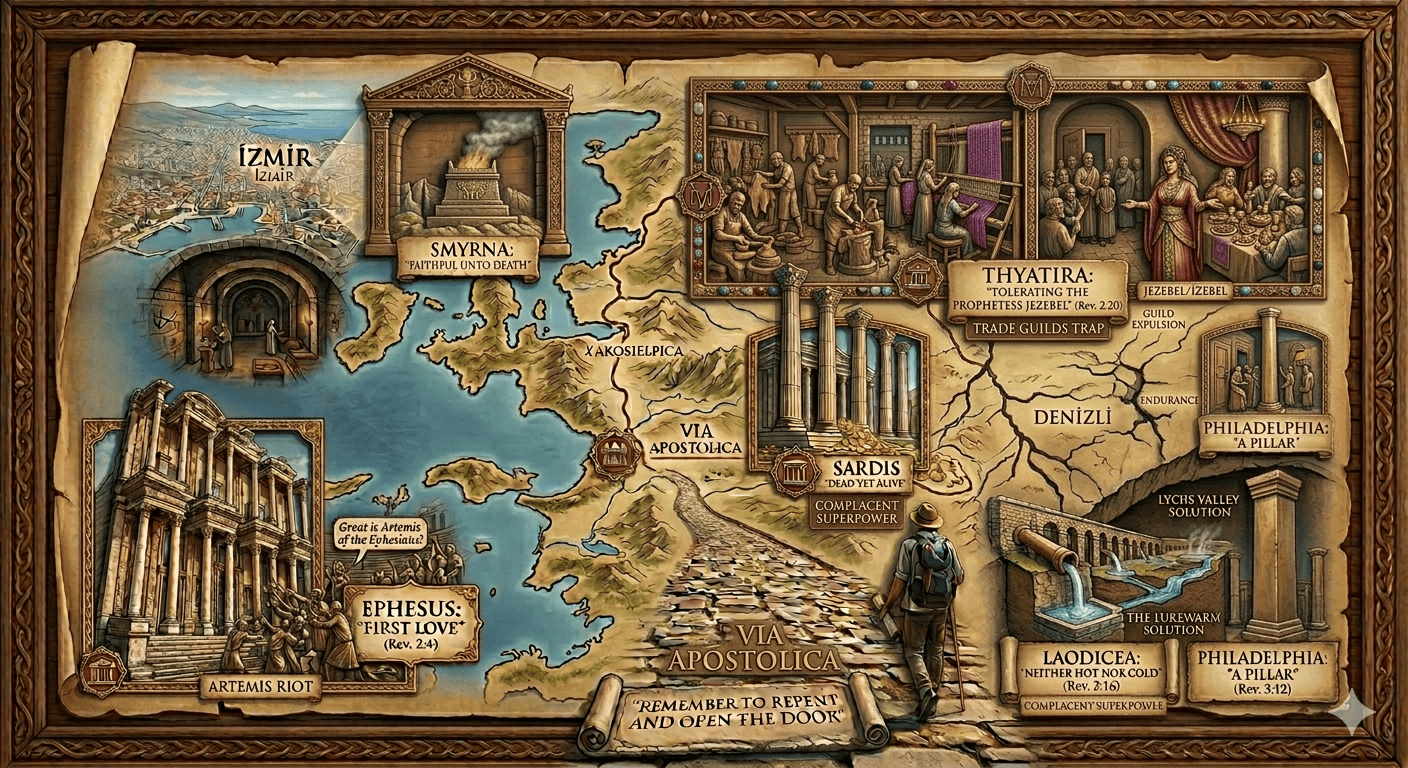
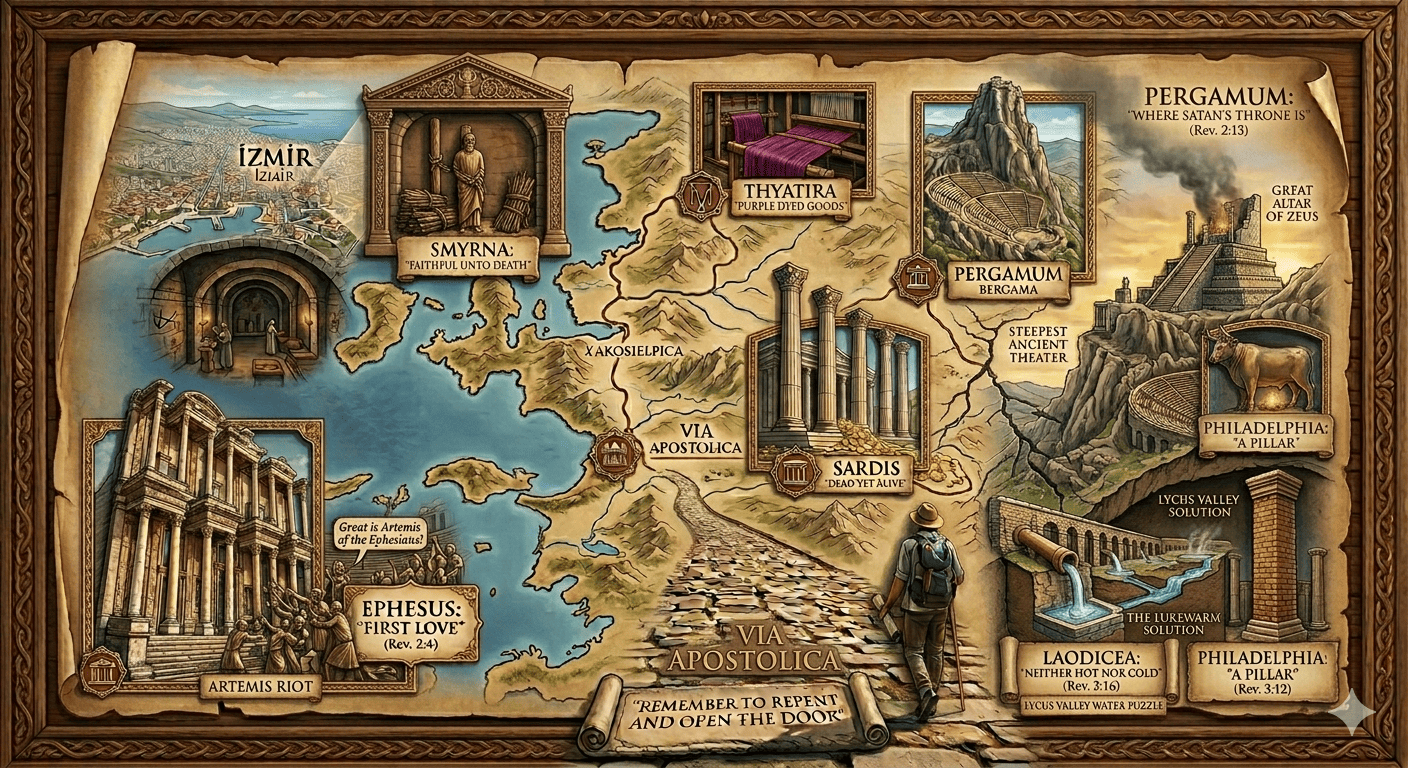
In the twilight of the first century, on the isolated and rocky island of Patmos, the Apostle John received a breathtaking and apocalyptic vision. He was instructed to write what he saw on a scroll and send it to seven specific faith communities in Asia Minor—modern-day Western Turkey.
These were not random choices. They were the geographic and cultural nerve centers of the Roman Empire in Asia. The letters sent to them in the Book of Revelation contained profound praises, sharp warnings, and timeless spiritual mirrors.
But as the centuries rolled on, empires crumbled, grand marble cities fell into silence, and the landscape transformed. Today, the ancient roads the couriers once walked are woven into the vibrant tapestry of the Turkish Aegean and Mediterranean coastlines.
If you were to trace the footsteps of the early Church today, where would those ancient scrolls take you? Let us journey through the geography of faith and discover where the Seven Churches of Revelation stand in the modern world.
1. Ephesus: The Loveless Church (Modern-Day: Selçuk, İzmir)
Once a bustling metropolis of over 250,000 people, a grand port city, and home to the Temple of Artemis, Ephesus was the crown jewel of Roman Asia. It was here that Paul preached, Timothy served, and John spent his final years. To this community, Christ acknowledged their endurance but warned that they had “forsaken their first love.”
Today: The ruins of Ephesus, located near the modern town of Selçuk, form one of the world’s most spectacular open-air archaeological museums. Walking down the marble-paved Curetes Street, standing before the magnificent Celsus Library, or sitting in the grand theater where the riots against Paul took place, history feels entirely alive. Just a few miles away, the Basilica of St. John marks the traditional burial site of the Beloved Apostle himself.
2. Smyrna: The Persecuted Church (Modern-Day: İzmir)
Smyrna was a wealthy, fiercely loyal Roman city known for its beauty and its requirement of emperor worship. Because of this loyalty to Rome, the early Christians suffered intense poverty and violent persecution. Christ’s letter to Smyrna offered no condemnation—only comfort, urging them to “be faithful, even to the point of death.” It was here that Polycarp, a disciple of John, was martyred.
Today: Unlike most of the other seven cities, Smyrna never became a abandoned ruin; it evolved. Today, it is İzmir, Turkey’s vibrant, cosmopolitan third-largest city. Right in the heart of this bustling modern urban center lies the Ancient Agora of Smyrna. Stepping into the Agora’s vaulted underground basilicat chambers allows you to walk the exact grounds where early believers maintained their faith under the shadow of Roman pressure.
3. Pergamum: The Compromising Church (Modern-Day: Bergama, İzmir)
Pergamum was a majestic city built upon a towering acropolis, celebrated as a center of philosophy, medicine, and pagan worship. It housed a massive library and the monumental Altar of Zeus. In Revelation, Christ refers to this city as the place “where Satan has his throne,” praising those who held fast to His name but warning against those who compromised with pagan culture.
Today: Pergamum sits high above the modern agricultural town of Bergama. A cable car takes visitors up to the breathtaking Acropolis. The ruins are dramatic, featuring the steepest ancient theater in the world, clinging to the hillside. Looking down from these heights, you instantly understand the literal and symbolic gravity of the spiritual battles faced by the Pergamene believers.
4. Thyatira: The Corrupt Church (Modern-Day: Akhisar, Manisa)
Thyatira was a specialized commercial center famous for its trade guilds, particularly its production of rich purple cloth (Lydia, the seller of purple textiles in the Book of Acts, was from here). The Christians here faced a unique challenge: to work in the guilds, they were pressured to participate in pagan feasts and moral compromise, a compromise symbolized in Revelation by the influence of a woman called “Jezebel.”
Today: The ancient city is located in modern Akhisar, a bustling hub known today for its olive groves. Because the modern city grew directly on top of the ancient one, only a single city block has been archaeologically excavated—known as the Tepe Mezarlığı (Hill Cemetery). Here, amid the roar of modern traffic, ancient arches and classical columns stand as a quiet reminder of a community called to remain pure in a compromised world.
5. Sardis: The Dying Church (Modern-Day: Sart, Manisa)
Sardis was once the legendary, ultra-wealthy capital of the ancient Lydian Empire, ruled by the famously rich King Croesus. Built upon a seemingly impregnable cliffside, the city fell twice in its history due to sheer arrogance and lack of watchfulness. This historical flaw mirrored their spiritual state; Christ warned them, “You have a reputation of being alive, but you are dead… Wake up!”
Today: Located near the village of Sart, the ruins of Sardis are monumental and deeply evocative. Ziyaretçiler can explore the massive Roman Gymnasium, a stunningly preserved 3rd-century Jewish Synagogue (one of the largest in the ancient world), and the colossal columns of the Temple of Artemis. The vastness of the ruins perfectly captures the contrast between past earthly glory and the spiritual wake-up call sent to its people.
6. Philadelphia: The Faithful Church (Modern-Day: Alaşehir, Manisa)
Philadelphia was founded as a cultural gateway to spread Greek language and culture into the interior of Asia Minor. It was a city plagued by frequent, terrifying earthquakes, causing residents to often flee to the open countryside for safety. To this faithful, enduring church, Christ offered no rebuke. Instead, He promised to make them “a pillar in the temple of my God” that would “never leave it.”
Today: The ancient site is located within the modern city of Alaşehir. While much of the classical city remains buried beneath modern life, the most striking Christian monument still standing is the massive, towering brick pillars of the 6th-century Church of St. John. These colossal ruins stand as a stunning physical manifestation of the biblical promise made to them: even when everything else crumbles, the pillars of faith remain standing.
7. Laodicea: The Lukewarm Church (Modern-Day: Denizli)
Laodicea was a booming financial center, famous for its wealthy banking houses, its medical school that produced a celebrated eye salve, and its soft, glossy black wool. Yet, for all its wealth, the city had a major flaw: its water supply. Water had to be piped in from nearby hot springs, arriving at the city walls neither hot nor refreshingly cold, but nauseatingly lukewarm. Christ used their own water, wealth, and industry to mirror their spiritual blindness: “Because you are lukewarm… I am about to spit you out of my mouth.”
Today: Located just a short distance from the famous white travertine terraces of Pamukkale and the modern city of Denizli, Laodicea is currently one of the most meticulously restored archaeological sites in Turkey. The vast site features beautifully reconstructed colonnaded streets, two grand theaters, and an ancient church building dating back to the Emperor Constantine era. Walking through its expansive ruins offers an unforgettable perspective on the perils of material self-sufficiency.
The Journey Continues
The Seven Churches of Revelation are not merely chapters in an ancient text, nor are they dead monuments frozen in time. They are real places, set in a landscape of breathtaking natural beauty, where the roots of Western history and Christian heritage run deep.
To look upon these stones today is to bridge the gap between prophecy and geography, gaining a timeless perspective on faith that still resonates across the centuries.
Are you ready to see these biblical landscapes with your own eyes? Explore our thoughtfully curated [Seven Churches of Revelation Itineraries] or connect with us to design your own custom spiritual pilgrimage through Turkey.